Sunday, February 27, 2011

Mid Winter Thaw

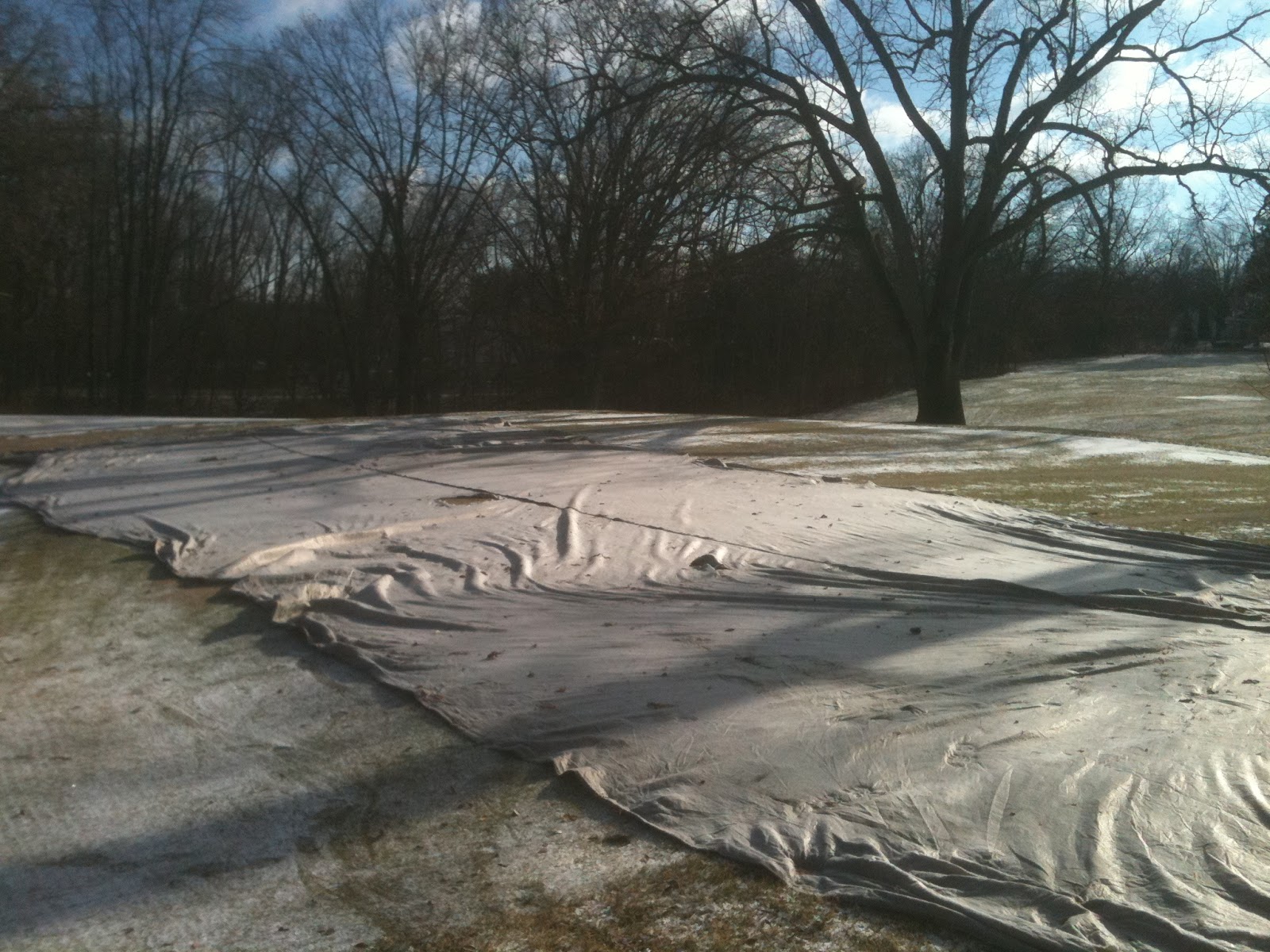
This is 18 green after clearing the snow . ( Also a thorough Pressley inspection!)

We saw our second thaw of the winter the week of February 13-19. We cleared all greens of ice and snow as well as surrounding banks that would melt down onto greens. Approximately 99% of the course was clear of snow and ice. We were able to inspect the turf and we were pleased as to what we saw. All turf preventively treated was free of winter disease(snow mold) and showed great color. The drainage furrows we cut into greens last fall to assist with water moving off the putting surfaces were working nicely.
Subsequently, 2 days later we received our biggest snow fall of the winter. Almost 11 inches came down on Sunday February 20. To date we are still covered course wide. All indications at this point show that so far mother nature and our work is keeping winter damage to a minimum. 

This is the putting green after snow removal.  We were able to successfully clear the three inches of ice seen in this photo.
Forecast shows further warming trends so we will have a constant eye on snow melt, possible ice build up, and turf conditions.

Saturday, February 5, 2011

Snow storm hype & grinding equipment

The blizzard that covered the country and hit Michigan on February 1'st and 2'nd dropped a total of 11 inches at Lakelands. The course and entire region is truly a winter wonderland. We spent most of the day on Wednesday and the morning on Thursday plowing the club road and parking lots. Our plan is to remove all snow from the greens the week of February 7-11.

Ryan Lee our equipment technician and I spent the day on Friday travelling to Canton, Ohio to look at a set of used grinders we are looking to purchase. After spending about an hour inspecting the two units, we made the decision they would work very well for us. Part of our capital purchases in 2011 is the purchase of grinding machines.  These machines are used to sharpen reels, and bed knives. These are the parts of the mower actually doing the cutting. A reel is made up of helix shaped blades attached around a steel shaft. The reel and cutting unit are removed from the traction unit, mounted into the grinder and automatically sharpened by a pre-programmed, spinning stone.
Dull or poorly sharpened mowers tear and shred grass blades rather than cut them. This shredding causes the tips of injured leaves to turn straw-brown and die within a few days. Such injuries also assist infectious agents to penetrate plants and cause disease. Mowers should be sharpened and adjusted frequently to prevent excessive injury and to stimulate turfgrass health.
As expectations for smooth, consistent and faster greens increase, the surgical cut produced from reels sharpened with Express Dual and Anglemaster results in a consistency of cut that enables golf courses to provide everything golfers have come to expect.

Why Use Grinders?
It may sound simple but, using grinders keeps your mowing equipment sharp.
Dull mowers tear or shred grass blades rather than cut them. By using mowers that are surgically sharp you improve the quality of cut that is applied to your turf everyday.
A good quality of cut means healthier turfgrass, smoother surfaces and beautiful greens, tees and fairways.

EXPRESS DUAL 3000MC


With easy to use electrical and mechanical control systems, the new Express Dual 3000MC is competitively priced to meet any golf course budget. Express Dual 3000MC comes with an electrical clamping system making reel grinding super easy and super fast. The simple feed system with digital display ensures balanced cylinder blade grinding every time.

  • Rigid, robust chassis
  • Automatic traverse
  • Flexible cylinder/reel drive
  • Digital feed controls
  • Electric clamping system
  • Single switch control
  • Lift and guard come standard
ANGLEMASTER 3000MC


The Anglemaster 3000MC offers speed and accuracy with simple mechanical control at a price and specification to suit your requirements. Applying Bernhard's approach of using a simple protractor with 'auto-cue' to find any desired angle, bottom blades can be sharpened to within one thousandth of an inch.
Independent in-feed and a single point advance make this the easiest bottom blade grinder on the market.

  • Simple to set-up and use
  • Accurate, grinds to within 0.001"
  • Can grind bottom blades up to 40" long
  • Automatic traverse
  • Coolant dispersal and separation come standard
grinder pictures and info courtesy of Bernhard Grinding Company

Tuesday, February 1, 2011

Is this is the BIG ONE!?!

How much snow are we going to get?  The more the bettter.  Hope everyone stays safe.
We will keep you posted on the course once it is all on the ground.

Monday, January 24, 2011

Winter Weather

On January 16, we received mixed precipitation of freezing rain followed by three inches of snow. Subsequently, there is a thin layer of frozen granular/ice on the greens. Through many conversations with other private club Superintendents in south eastern Michigan, and the guidance of the faculty at MSU, ice should not be left on the greens longer than 30 days. The countdown began on 1-18-11.
Stay tuned for future developments.

1/1/2011

Happy New Year!
We have spent  a lot time checking and clearing greens this holiday season.  After being in touch with many other Superintendents in the area regarding ice we seem to be fairing well so far. Some Superintendents are seeing a honeycomb ice accumulation after clearing their greens.  So far Lakelands has had major snow melt however nothing as far as ice.  Obviously this can change on an hourly basis.  There are just two of us in right now so know we are managing to the best of our abilities in the sunlight hours. Our goal is to come out of this winter with much less damage as years past!

12/25/2010

As our focus turns to family and friends I am so grateful for Lakelands.  From our family to your, Merry Christmas

Wednesday, November 24, 2010

More winter prep


These are called furrows.  They allow for additional drainage of water during winter months. 


The sod we cut out of the greens, we placed in the bunkers. We will replace this sod in the spring. 

  In an effort to conserve our capitol expenditures, we have utilized several covers that with much TLC will hopefully adequately protect us for the winter. These covers were purchased 15-20 years ago.
The idea of green covers:

The Other Side of Covers

By Bob Vavrek, Senior Agronomist
November 18, 2008
Courses across the north-central tier of states have recently completed the annual tasks of winterizing the irrigation system and applying snow mold fungicides to high priority playing surfaces. With cold, snowy weather looming, many superintendents now wonder if there are any other options available for protecting the course from winter-related damage during these final few weeks of late fall.
A moderately heavy application of sand topdressing made after winter disease protection is applied is not a bad idea, regardless of where in the Region your course is located. The sand provides a fairly good level of protection from wind desiccation during an open winter and the addition of more sand into the upper root zone helps dilute excess organic matter accumulation that occurs between late fall through mid spring. In addition, just about any type of geotextile cover can help prevent damage to turf across open, elevated, windswept greens or tees that have a history of winter desiccation.
On the other hand, I cringe when inquiries are made regarding the use of winter covers on greens at golf courses located along the southern border of the Region, for example the Detroit area. The winter climate along this portion of the country is far too unpredictable and, in my opinion, the problems associated with a surge of excessive growth that could occur under a cover will always outweigh any protection from crown hydration the fabric may provide. Covers tend to perform best in areas where there is little risk of an extended mid-winter thaw.
That being said, don't be afraid to cover a poorly drained, localized area of a green that dies year after year due to crown hydration or prolonged ice cover. After all, what's the risk when you are sodding or plugging a portion of this green every spring anyway. Under these conditions, the use of a wood fiber mat or an insulated waterproof cover over the injury prone area of the green is worth a try until the underlying problems associated with poor surface drainage can be addressed by reconstruction or through modification of the surface contours.
Just keep in mind that you need to look past the advertising hype associated with green covers, particularly in areas of the Region where a period or two of mild winter weather is likely to occur before spring. If a product is likely to cause the turf to break winter dormancy, you may be better off covering your backside, by not covering your greens.
Source: Bob Vavrek, rvavrek@usga.org or 262-797-8743